LinkIndexPrint
Contents
 Welcome
    Ask MaxiPlan
 Using Cascade Planning
    Data Entry Shortcuts
 Working with Planning Projects
    Designing A Cascade Project
    Project Management
       Creating and Maintaining Projects
       Period Sets
       Currencies
       Creating A Splash Screen
       Allowing Other Users Access
       Backup and Restore
       Virtual Period Definition
       Deployment Alias
       Publish Documents
       Project Status
    Building an Application
       Building Application Models
          Building A Cube Model
             Basic Setup
             Selecting a Period Set
             Measure Settings
                Defining the Measures List
                Setting Measure Attributes
                Measure Formatting
                Defining Calculations for Measures
                Other Functions for Measures Editor
                Cross Referencing Measures
                   Dimension Order in Planning Models
                   Cross Referencing Within The Same Model
                   Cross Referencing to Another Model Cube
                   Cross Referencing to the Parent of the node
                Measure Logic Functions
                   PREVIOUS function
                   SUM function
                   MAX function
                   MIN function
                   DEPRECIATION function
                   INT function
                   ROUND function
                   ROUNDUP function
                   ROUNDDOWN function
                   IF Function
                   SWITCH Function
             Dimension Settings
                Defining Dimension Lists
                Defining Dimension Properties
             Miscellaneous
             Finishing The Model
             Advanced Features
                Specifying Consolidation Logic
          Building A Transaction Model
             Basic Set Up
             Defining Dimension Lists 
             Defining Transaction Model Fields
             Additional Definition for a List Field
             Additional Definition for an Expression field
             Additional Definition for a Lookup Field
             Optional Validation for Text, Date, Integer & Value Field
             Defining Field Format & Access
             Miscellaneous
       Model Flow and Linking Models
          Using Links (the 'Push' Method)
          Cross Referencing (the 'Pull' Method)
       Deployment and Workflow
          Deploying Models for Input and Review
          Allowing Users to Extend Models
          Setting up and Managing Workflow
          Workflow for Users
       Advanced Project Functions
          Measure Filters
          Jobsets
             Defining A Jobset
             Run Jobsets
          Data Integration
             Create Dynamic Model
             Import to Cube
             Import to Transaction
             Export Cube Data
          Maintenance
             Model Maintenance
             Link Maintenance
             List Maintenance
             Calculate all cubes
             Versions
          Pre/Post Rules
 Reports and Scripting
    Define Scripts
    Define Reports
    Publish Documents
    Manage Scripts


Home > Working with Planning Projects > Building an Application > Building Application Models > Building A Transaction Model > Additional Definition for an Expression field

Additional Definition for an Expression field
Last Updated 2/28/2012 2:19 AM


Additional Definition for an Expression field (Numeric or String)

Selecting the Numeric or String Expression data type, will prompt for additional information using a pop-up display.

For Numeric Expression, it will list all the numerical data type (INTEGER, VALUE, DATE, Numeric Lookup), as for other Numeric Expression field you have to type the field name manually.
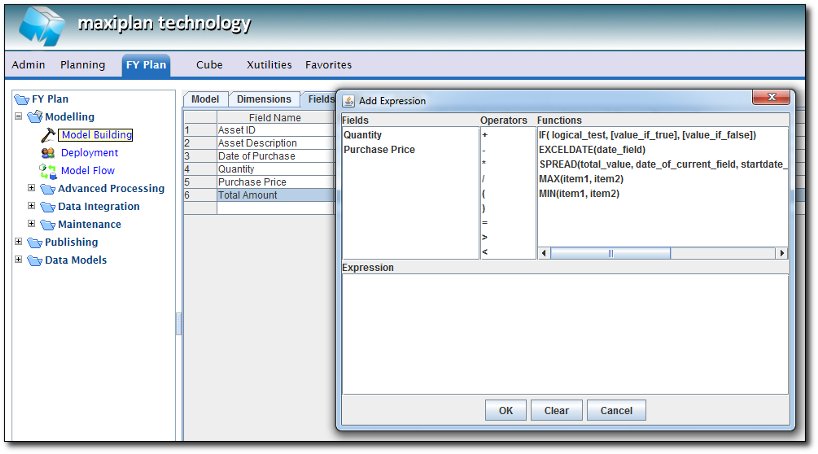

    There are some operators can be used in the formula : +, - , *, /, (, ), = , > , < 

    And there are some functions can be used in the formula :

    IF (Logical_test, value if true, value if false) - to check a condition from another numerical field
    EXCELDATE (date_field) - to return an excel date from a Date field
    SPREAD (total_value,date_of_current_field, startdate_of_the_spread,enddate_of_the_spread,m|y|d) - to Spread a value based on the given date in the formula
    
        Total Value : The total amount that will be spread per month, year or day , depending on the last argument 'm','y','d' 
        Date of Current Field: This is the period into which the spread amount will be calculated. It will assume day, month or year according to the date,  eg 3/2/09 will assume February for month spreading, 2009 for year spreading etc 
        Start date of the Spread: This is the first day of the date range to be spread into 
        End Date of the Spread: This is the last day of the date range to be spread into. 
        'M','Y','D': Periodicity to be spread into.

        Example : For Field Called January , = SPREAD(total value ,'1/1/09',start date ,end date ,'m'), where total value, start date, end date is referring to other field

    MAX(item1,item2) - to find whichever field has the highest value
    MIN(item1,item2) - to find whichever field has the lowest value   

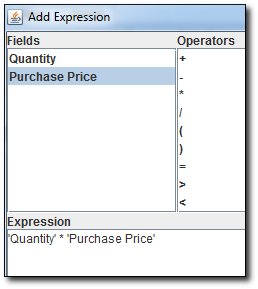
    For example, if we want to build a CAPEX model, where we define the Quantity of item & Price for each item, we can calculate the Total Amount to be Quantity * Purchase Price
    

For String Expression, it will list down all the text type field
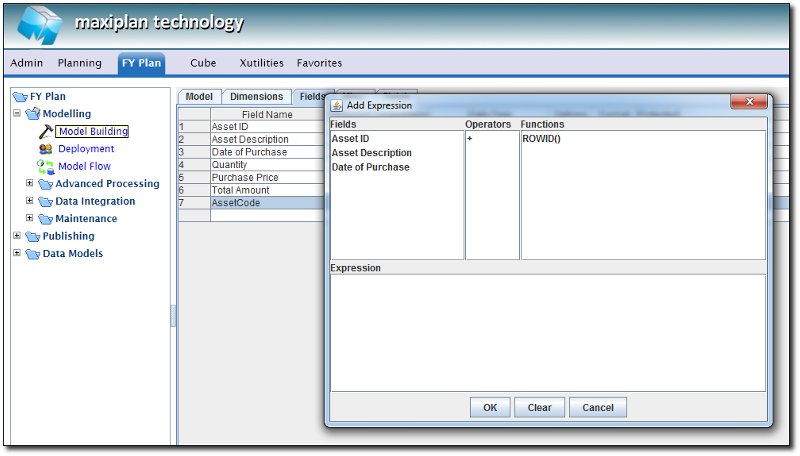


    The only available operators is + , which is used to combine text fields 

    The only functions available is ROWID() which is returning the number of the Record Rows.

    For example of CAPEX model, where we want to combine the Asset ID & Asset Description to be AssetCode field, we can put the string expression to be like this :
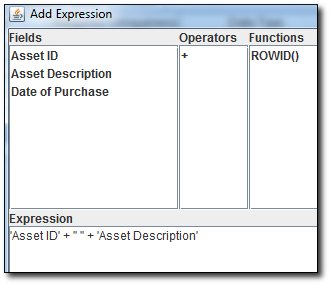
    

    For any string that need to be included into the Expression, you will need to use double quote " in between


See also